Contested Unity
Published:
Full paper (PDF). Draft in progress; comments welcome at eizadi@uvic.ca.
Imagined communities, then a nagging question
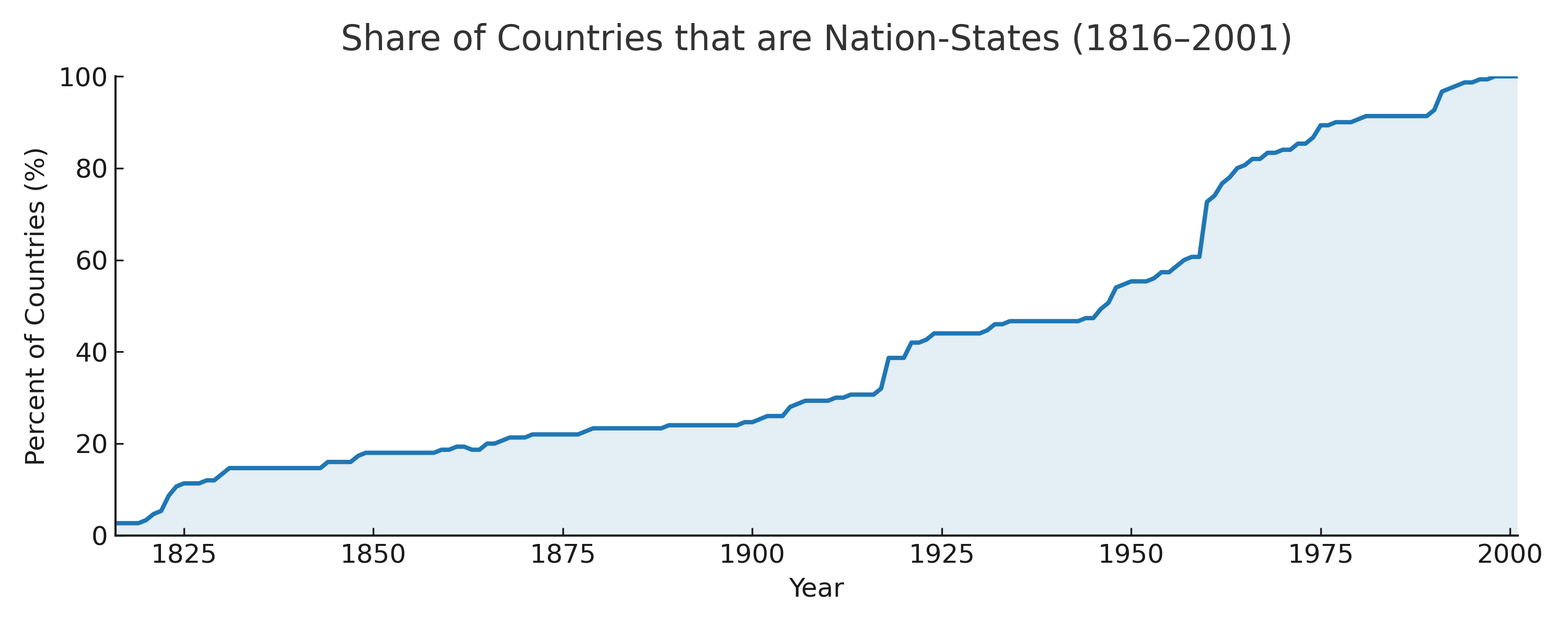
After finishing a paper on the institution of the nation-state (the figure above is created from the data in a related work by Andreas Wimmer), I kept circling the next question: what do we actually mean by national identity, at least in economics?
“Nationalism: an infantile disease. It is the measles of mankind.” (Albert Einstein)
That line sticks because the bad reputation is not undeserved. Nationalism can mobilize solidarity, and exclusion. So what do development economists do with this tension? One impulse emphasizes a shared identity for coordination, trust, and state capacity. The other warns that nation-building can crowd out pluralism or backfire.
A tiny taxonomy I find useful
Here’s the organizing thought behind my paper: if we accept a simple chain:
nation-state → nation-building → (a technology of) coordination → national identity,
Then the “technology” is just public policy, and in modern states the main lever is redistribution. In other words, identity formation isn’t mystical; it’s co-produced with the budget choices the state makes.
Concretely, I model a majority allocating a fixed budget each period across:
- a majority-specific good,
- a minority-specific good,
- and a common good (curriculum, shared language, civic programs).
The common good yields some value today and raises the chance of a more civic, integrated polity tomorrow. Identity is the outcome of this repeated bargaining over public goods, not a primitive.
Three regimes, in plain language
Exclusionary. The majority prioritizes itself. No weight on minority welfare or preferences; little to no integration effort.
Split / “multicultural” appeasement. Each group gets its preferred good. The pie is divided, coordination remains costly, and everyone pays for the duplication.
Common-good (civic) regime. The state invests in a not-anyone’s-ideal common good, civic infrastructure that can pave the way for a stronger, more legitimate welfare state later.
The paper’s point isn’t to moralize these categories, but to show when each emerges. Two forces do most of the work: a political trade-off (immediate group benefits vs. deterring conflict and nurturing a civic future), and intertemporal misalignment (today’s citizens undervalue tomorrow’s integration).
This post sketches the intuition. The working paper puts the pieces into a dynamic model and traces the conditions under which polities drift toward exclusion, get stuck split, or converge to civic nationalism.