What are political connections worth, and why do they fade?
Published:
This post sketches the intuition behind a working paper with Addisu Lashitew, Rizal Shidiq, and Eric Werker on political connections, firm growth, and networks in Indonesia. Full paper (PDF).
Measuring a connection as a matter of degree
Most studies treat political connection as a switch: a firm either has a politician on the board or it doesn’t. That throws away information. A tie to a marginal opposition figure is not the same as a tie to a ruling-coalition heavyweight, and a party’s clout shifts election to election.
So we build a continuous, power-weighted connection score. The weighting starts from how much power each political party actually holds over time:
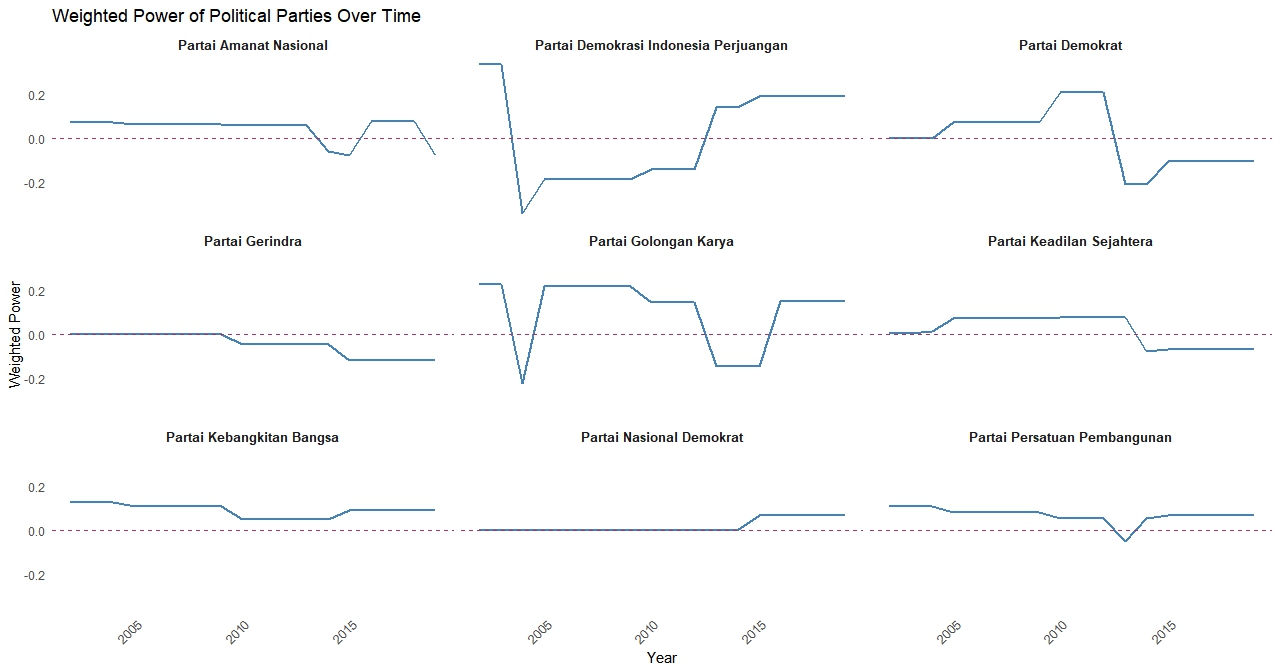
Each panel is one Indonesian party’s weighted power across the 2004–2019 electoral cycles. Golkar and PDI-P swing sharply as coalitions form and dissolve; smaller parties drift. A firm’s connection score inherits this dynamics: being tied to a party is worth more in the years that party is ascendant. We then map these party weights onto a panel of publicly listed firms (2002–2019).
The headline, then the twist
Using a dynamic panel model, the first result is the expected one: stronger political ties go with higher asset growth, sales, and leverage. Connected firms are bigger and borrow more.
The twist is what happens when we add the firm’s position in the inter-firm network, who it transacts with, co-owns with, shares directors with. Much of the political premium fades. The connection was standing in, statistically, for something else: embeddedness in a web of business relationships.
Connections as a substitute for institutions
That points to a channel the literature under-weights. In economies with weak formal institutions (thin contract enforcement, rationed credit), political connections may help firms less by delivering direct state favours and more by opening the door to business networks that provide informal governance: trust, referral, dispute resolution.
The evidence fits: the benefit of political connections for size and growth is largest for firms that start with the weakest network access. Political capital has its highest marginal return for the peripheral firm that has no other way in. For a firm already central in the network, an extra political tie adds little.
Why it matters beyond Indonesia
If connections work partly by substituting for missing institutions, then the “cost” of cronyism is not only the rents it redistributes, it’s the institutional development it lets a country postpone. It also reframes the policy question: strengthen the formal institutions that networks and connections are quietly standing in for, and the private returns to political connection should erode on their own.
This is the applied-econometrics companion to my more theoretical work on elites and institutions. Comments welcome at eizadi@uvic.ca.